
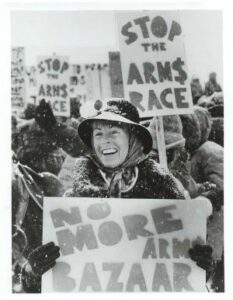
Marjorie Craig Benton is a lifelong activist and philanthropist. Her activist spirit was nurtured from a young age, and her marriage to Charles Benton in 1953 gave her the financial resources to unleash her philanthropic work. Marjorie began her service work in Evanston, fighting segregation and protesting the Vietnam War. She served as a special delegate to the UN Special Sessions on Disarmament, U.S. Ambassador to Unicef, board chairwoman of Save the Children Federation, and secretary of the Governing Board of The Bulletin of Atomic Scientists. She co-founded the Chicago Foundation for Women and the Chicago Peace Museum and currently works with Partners in Health in Haiti.
Significance
Marjorie Craig Benton was born the youngest child of seven in the suburbs of Philadelphia in a deeply conservative Irish family during The Great Depression. Benton’s parents, James and Edith, ran a strict household emphasizing personal responsibility and hard work. Marjorie had to work for her own spending money which began in her childhood with yard chores, paper routes, and babysitting. She even had to save for her own college fund, working as a waitress, ambulance driver, and underwear model. As a child, Marjorie attended a Quaker school for three years where the mentorship of a social studies teacher who introduced Marjorie to the joys of giving back. The pair often took service trips into the slums of Philadelphia. A seed was planted that would grow into a lifetime of service and philanthropy.
The Craig household was a bastion of Republican support, with James being a stringent opponent of Franklin D. Roosevelt and his New Deal initiatives. Her father’s lambasting, however, sparked a curiosity in Marjorie that was inflamed in college, especially after she met her husband Charles Benton, whose family were powerful Connecticut Democrats. In fact, Marjorie’s father-in-law Bill was the first U.S. Senator to denounce Joseph McCarthy’s anti-communist witch hunt in the 1950s. Once Marjorie entered the life of the Bentons—filled with riches and elite political connections—her drive to leave the world a better place would be unleashed with incredible fervor.
Marjorie and Charles married in 1953 and soon moved to Evanston, where they raised their three children: Adrianne, Craig, and Scott. At the time, Evanston was a Republican stronghold, but the couple remained steadfast in their Democratic allegiance. They quickly became involved with the Evanston Unitarian Church where minister Homer Jack helped nurture their activist spirits. The pair, along with their children, began marching for civil rights, open housing, desegregated schools, against the Vietnam War, and for disarmament. Marjorie fought hard to maintain a balance between her activism and her role as a mother. In fact, she was once jailed for participating in a sit-in, protesting segregation while her students were at school. Her political ideologies and childhood experiences shaped how she raised her children. Household chores were mandatory, and war-themed toys were forbidden. Her youngest son Scott called her “very tough, yet very fair.”[1]
While raising her children, Marjorie remained active in local and national politics, advocating for nuclear disarmament, engaging local voters, and working for George McGovern’s 1972 Presidential campaign. Though McGovern lost the election, Jimmy Carter’s election in 1976 provided her a new ground in which to work when he appointed her as a delegate to the U.N. Special Sessions on Disarmament. Marjorie expanded her work on arms control by becoming a cochair of Americans for SALT (Strategic Arms Limitations treaty). She stood out during the Cold War for her balanced approach to disarmament. At a time when Soviet proposals were unilaterally rejected, she insisted on cooperation between the two superpowers. She told the Chicago Tribune, “That just drove me nuts when I was actively involved in negotiations. We can’t be naïve, but I’m suggesting that we carry the dialogue a little further.”[2] Marjorie continued her national and international work, becoming an ambassador for UNICEF, working as a delegate on four UN commissions, serving as a delegate to the DNC four times, and co-founding Chicago’s Peace Museum.
Marjorie’s international work intensified after her work with UNICEF and the UN. During this time she also joined the Save the Children Federation, an international aid organization for women and children. Marjorie began travelling around the world to provide hands-on relief for starving children, refugees, and impoverished women. During these trips, she lived as the locals did. She slept on the ground, under the stars, eating what they ate. Her commitment to being active in the work on the ground enabled her to create economic opportunities for women across the world. During a trip to Amman, Jordan, she noticed splendid rugs inside a refugee shelter of a woman that had invited her to tea. After realizing that local women had traditionally made these rugs but they no longer had a market or sheep for wool, Marjorie jumped to work, securing sheep for the women and customers for their rugs. The sales were so impressive that the women were able to use the profits to build a school, a clinic, and hire a midwife. Marjorie’s work sought not just to provide temporary aid, but to find ways to create opportunities for women that could be sustained long term.
As America began to slowly drift rightward during the Reagan Presidency, Marjorie bucked national trends by remaining a dedicated liberal Democrat. She lambasted the Me Generation and the ‘greed is good’ movement and even criticized Reagan’s administration saying, “I think the theme of this administration is every person for himself. I think there is a mean-spiritedness towards people who don’t have anything.”[3] Her frustrations only fueled her work, and in 1985 she co-founded the Chicago Foundation for Women (CFW), a non-profit grantmaking organization to provide resources and support for women and girls in the Chicago-land area. The CFW has given out tens of millions of dollars throughout the decades supporting women’s work and activism.
Marjorie’s philanthropic work continued through the 1990s and 2000s, providing life-saving aid to people across the world. After the 2010 earthquake in Haiti, she began work on building a new hospital and medical infrastructure in the country. It was the first hospital in the world sustained entirely from solar power. During the COVID pandemic she created a new women’s association for Partners in Health. Most important for Marjorie is the mentoring she does for young women seeking to make a difference. Even in her 90s, she continues to meet with women in Evanston to help them find their own service and philanthropic paths. Her goal continues to be what it has always been: empowering women.
By Sarah Barton, for the Evanston Women’s History Project
[1] Catharine Reeve, “A wealth of causes: For Marjorie and Charles Benton activism and the good life go hand in hand,” Chicago Tribune, (February 9, 1986).
[2] Catharine Reeve, “A wealth of causes: For Marjorie and Charles Benton activism and the good life go hand in hand,” Chicago Tribune, (February 9, 1986).
[3] Catharine Reeve, “A wealth of causes: For Marjorie and Charles Benton activism and the good life go hand in hand,” Chicago Tribune, (February 9, 1986).