
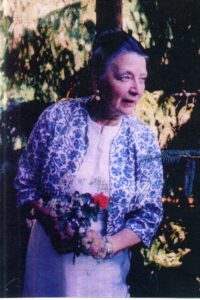
Alvina Krause was foundational to the creation of the Northwestern acting program and brought it national acclaim through her teaching and acting philosophies. When Krause was first hired, acting was a simple one-year program, but she managed to transform and expand it into a three-year program that helped shape some of the nation’s finest actors, including four Academy Award winners: Charles Heston, Cloris Leachman, Jennifer Jones, and Patricia Neal.
Significance
Alvina Krause was born into a small-town Wisconsin farming family with an innate curiosity about people and why they behaved certain ways. Her love for the arts was nourished through reading and gave her the drive she needed to leave her small town of New Lisbon, Wisconsin. Krause was drawn to teaching from an early age and as a senior in high school, she turned down a marriage proposal, saying “Why, I’m going to have a career. I’m going to do things. I’m not going to get married.”[1] After graduation she went on to study at Cumnock Oratorical School before becoming a high school teacher for several years. During this time she taught in Springfield, Missouri where she met Lucy McCammon, her life partner. The pair lived separately for several decades as McCammon taught physical education at Bloomsburg State College from 1926-1958 and fought for the inclusion of women in varsity sports. After decades apart, the pair were finally able to live together when Krause joined McCammon in Bloomsburg in 1971 until Krause’s death.
Krause earned her bachelor’s degree from Northwestern University in 1928, after which she continued teaching in high schools across the country. After several years in the high school classroom, Krause moved to St. Paul to teach drama at Hamline University. While at Hamline, Krause brought her students to perform at a Northwestern drama festival. Faculty at the festival were so impressed with Krause’s students that they offered her a position at Northwestern, where she taught for 34 years. In 1963 when Krause reached Northwestern’s mandatory retirement age, the university tried to force her into retirement. However, a wave of protests from current and former students made the university change their mind, keeping her on for another five years. In a letter to university officials, students wrote, “Great teachers in any subject at any time are rare and Miss Krause is surely one of them. She is a source of inspiration and a reference point of glowing integrity.”[2] The indignity over Krause’s forced retirement traveled as far as New York with former student and famous actress Paula Prentiss calling the university to express her anger over the situation.
Krause saw theatre as a way to reach people and move people to care for others and their unique problems. Krause encouraged students to journal everything they saw around them and experienced as sources of inspiration for their performances and characters. Though the journals were confidential, she would often use anecdotes from the journals as acting prompts in class. Many of Krause’s methods were quite intense. One student spoke of how Krause slapped him across the face to draw an emotional response out of him before he went on stage. Krause’s approach to theater emphasized the production and ensemble rather than a single shining star. In 1968 she complained about the changing face of theater, “We’re saddled with a star system that creates personalities, not actors,” and noted, “The play is the star, the whole company, not just an individual.”[3]
Krause’s commitment to ensemble performances paralleled her love for community theatre. During her life, she helped found three separate theaters: Eagles Mere Playhouse on the NU Campus (1945), Chicago’s Harper Theatre (1966), and the Bloomsburg Theater Ensemble (1977). Each of these theatres remain in operation today and are crucial to the artistic communities which surround them. After her retirement, Krause joined her partner McCammon in the small town of Bloomsburg, Pennsylvania where she continued to work with local actors and stage productions. During her later years, Krause received several well-deserved honors including the Key to the Town of Bloomsburg, an honorary doctorate from Doane College in Nebraska, Northwestern’s first President’s Medal, a Centenary award from the American Association of University Women, and one of the first Hazlett Memorial Awards for excellence in the arts from Pennsylvania Governor Dick Thornburgh. In fact, Governor Thornburgh spoke at her funeral, calling her, “one of the Commonwealth’s most distinguished citizens.” [4]
By Sarah Barton, for the Evanston Women’s History Project
[1] McCants, Billie “Alvina Krause on Women in Theatre”. In Chinoy, Helen Krich; Jenkins, Linda Walsh (eds.). Women in American Theatre 3rd ed, (New York, NY: Theatre Communications Group), 2006, 113.
[2] Margaret Scherf, “Personalities, Not Actors, Created: Star System Strangles Theater,” The Decatur Daily Review, January 28, 1968.
[3] Margaret Scherf, “Personalities, Not Actors, Created: Star System Strangles Theater,” The Decatur Daily Review, January 28, 1968.
[4] Susan Brook, “Many gather to remember Krause,” The Morning Press, January 11, 1982.